Of course, the apparent immortality of these species is conditioned by our own time-frame of observation. The verification of eternity poses a paradox because it requires a frame of reference that is equal to, or even more durable than the local event to which such an adjective is attributed. Therefore, we will limit ourselves to say that this immortality refers to life spans much longer than the current life span of an average human being. We have witnessed these “relative eternities” with respect to ours, and we can learn a great deal from them. The first thing they teach us is that it is possible to live much longer. Let’s look at some examples:
The Ming Clam
The Ming clam had an estimated longevity of over 400 years when it was pulled from the ocean in 2006, at a depth of 88 m and about 10 km west of the southern tip of Grimsey Islet (40 km north of Iceland). The clam was named by scientists as Ming because it was born during the reign of the Ming dynasty in China and died because of the study to determine its age more accurately.
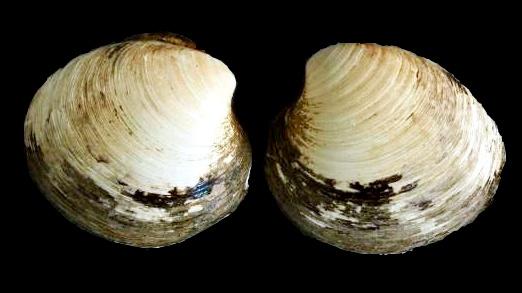
The Ming clam (Arctica islandica). Source: Museo Nacional de Historia Natural.
Scientists rectified the age to be 507. Therefore, Ming was born around 1499, only a few years after Columbus discovered America and more than a decade before the Reformation of the Catholic Church by Martin Luther [1]. Perhaps it would have lived hundreds of years longer, or perhaps it would have died shortly thereafter; we are limited by a frame of observation that combines several factors, such as finding very long-lived specimens, and the time we can observe them.
The Planaria Worm
Planaria are a type of worm found all over the world and have an unlimited capacity to regenerate stem cells, being able to regenerate if they split in two. The University of Nottingham published a study on their potential immortality [2,3], which is apparently based on the presence of an enzyme called telomerase, that prevents telomere shortening. Telomeres are the ends of chromosomes, which help protect the DNA. When the cell divides in two (a process known as mitosis) and the chromosomes reproduce, the telomeres shorten slightly because the division does not reach the tip of the chromosome. Shorter telomeres shorten the lifespan because the cell is replicating progressively less effectively. This replication deficiency is responsible for the aging of a living organism.
 Planaria worm
Previous work had already shown that telomeres were fully conserved by telomerase activity. In most organisms that are produced through sexual mechanisms, this enzyme is active only during the early development of the organisms produced. Thus, over time, telomeres begin to shrink in size.
A study led by Dr. Aziz Aboobaker [2,3] predicted that the Plenaria worm actively maintains its chromosome endings in adult stem cells, which would lead to immortality, at least theoretically. This motivated a study [2], the purpose of which was to identify a “planarian” version of the gene coding for this enzyme, and to switch off its activity. This would result in a decrease in the telomere, which would prove that this is indeed the gene responsible for this function.
They were then able to confidently measure its activity and resulting telomere length and found that asexual worms dramatically increase the activity of this gene when they regenerate, allowing stem cells to maintain their telomeres as they divide to replace missing tissues.
Dr Aboobaker concluded: “Asexual planaria worms demonstrate the potential to maintain telomere length during regeneration. Our data satisfy one of the predictions about what it would take for an animal to be potentially immortal and that it is possible for this scenario to evolve. The next goals for us are to understand the mechanisms in more detail and to understand more about how you evolve an immortal animal.”
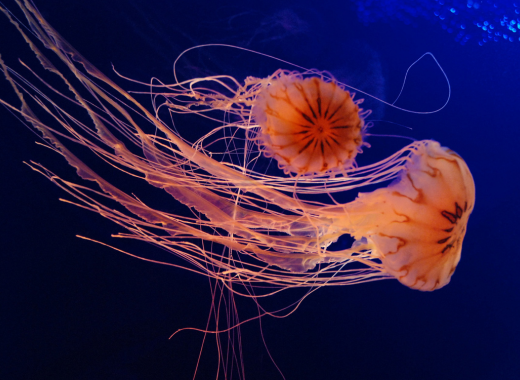
Turritopsis dohrnii, the “immortal Jellyfish”
The so-called immortal jellyfish – or Turritopsis dohrnii – inhabits the waters of the Mediterranean Sea and the Sea of Japan. It is very small, about 4.5 mm wide and tall, and loves to eat plankton, fish eggs and small mollusks. It was discovered in the 1880s in the Mediterranean Sea, and can now be found in many other places due to waste water dumped by ships.
 The so-called immortal jellyfish – or Turritopsis dohrnii –
The life of this jellyfish develops in a cycle that can be extended ad infinitum; it can restart its life cycle. Faced with an environmental or physical threat, disease, or aging, it transforms into a previous life stage, the polyp stage, allowing individuals of the species to perpetuate themselves in a constant process of aging and rejuvenation thanks to a cellular process known as transdifferentiation. Transdifferentiation occurs when a fully formed specialized adult cell – not a stem cell – becomes another type of adult cell. This process can be chemically induced [4] though its mechanism remains a mystery in science.
In addition, when the jellyfish returns to its previous life stage as a polyp, it creates more organisms with the same genetic code, so as it rejuvenates it also clones itself.
The American Lobster
The American lobster maintains an impressive ability to regenerate even in old age and its longevity may be connected to the behavior of its DNA, for the same reason as the planarians: the presence of telomerase enzymes [5].
The 1998 study [5] revealed that in the American lobster, telomerase is found in all its organs, where it presumably helps to maintain the conditions of the original young cells for a longer time.
However, lobsters are not immortal because indefinite growth forces them to periodically and constantly renew the exoskeleton that protects them and which, once formed, does not change size. At a certain point in the life of the lobster, the metabolic effort, or amount of energy needed to change their shells exceeds their own possibilities, causing them to die, sometimes by exhaustion, and sometimes by the collapse of their own armor.

The American Lobster
There are also species that, although not immortal, have an amazing capacity for body regeneration, as is the case of the famous Mexican axolotl, which we will discuss in a next article.
Unified Science In Perspective
It is important to note that most of these long-lived species live underwater. What does this tell us about the importance and role of water?
We know that water is fundamental to life, though its role seems to be much more fundamental than what is already known. For example, Nobel laureate Luc Montagner had reported that water has memory (see the documentary below).
Work from Dr. Gerald Pollack [6,7] about the EZ (exclusion zone) water, which is structured water near hydrophilic interfaces, finds that the EZ region is negatively charged. Pollack also hypothesizes that when light is shined on EZ water it causes positive and negative charges to separate and the EZ water region to grow, becoming a sort of modulable capacitor, that makes us think of this region as some sort of electronic device.
Could it be then that some phases of water could work like a liquid crystal, and have memory storage capacities? Liquid crystal behavior has already been reported in water by studies performed at Stockholm University [8].
Being able to understand water on a molecular level by watching the changes of the hydrogen-bond network, can play a major role in biological activity.
Fivos Perakis, assistant professor in Physics at Stockholm University [9].These novel features of water could have significant implications for the underlying mechanisms that explain life and the longevity of the living systems.
References
[1] https://phys.org/news/2013-11-reveals-ming-mollusk-years-older.html
[2] Thomas C. J. Tan, Ruman Rahman, Farah Jaber-Hijazi, Daniel A. Felix, Chen Chen, Edward J. Louis, and Aziz Aboobaker. Telomere maintenance and telomerase activity are differentially regulated in asexual and sexual worms. Proceedings of the National Academy of Sciences, February 27, 2012 DOI: 10.1073/pnas.1118885109
[3] https://www.sciencedaily.com/releases/2012/02/120227152612.htm
[4] X. Xie, Y. FU amd J. Liu, Chemical reprogramming and transdifferentiation, Curr Opin Genet Dev 46, 104 (2017). DOI: 10.1016/j.gde.2017.07.003.
[5] W Klapper, K Kühne, K K Singh, K Heidorn, R Parwaresch, G Krupp, Longevity in lobsters is linked to ubiquitous telomerase expression, FEBS Lett 13,439(1998). DOI: 10.1016/s0014-5793(98)01357-x
[6] Xavier A Figueroa and Gerald H Pollack, Exclusion zone formations from discontinuous Nafion surfaces, Int J Des Nat Ecodyn 6, 286 (2011). doi: 10.2495/dne-v6-n4-286-296.
[7] Gerald H Pollack, The Fourth Phase of Water: Beyond Solid, Liquid and Vapor, Published by Ebner and Sons (2013).
[8] K.H.Kim et al. Anisotropic x-ray scattering of transiently oriented water. Physical Review Letters 125, 0760002 (2020), DOI: 10.1103/PhysRevLett.125.076002
[9] https://phys.org/news/2020-08-x-rays-liquid-crystal.html