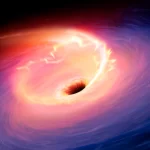
Based both on a graviton-condensate description of a black hole and on a correspondence between black holes and generic objects with maximal entropy compatible with unitarity – called saturons-, Dvali et al. propose that black holes could be understood as a graviton condensate at the critical point of a quantum phase transition. A graviton is a hypothetical quantum of gravity; an elementary elementary particle yet undiscovered that would mediate the force of gravitational interaction. Saturons are a saturated state collective behavior of gravitons, i.e., a Bose Einstein Condensate (BEC) of gravitons, situation that is possible when gravitons are confined in a volume of space, such as in a rotating system, and therefore become a bounded system. When the bound is saturated, meaning that the packing of gravitons is maximal, the object becomes a saturon Bose Einstein condensate of gravitons.
Since rotating Bose-Einstein condensates have been subject to intense studies in laboratories, it is known that they admit vortex structure if rotating sufficiently fast. We took this as an invitation to look for those structures also in models for rotating black holes—and indeed found them.”
– Dr. Kühnel, for Phys. News In such saturated state, this BEC reaches a maximal microstate entropy permitted by unitarity (the so-called saturons) and acquire properties similar to black holes. Their similarities have been demonstrated on different cases, such as solitons, baryons and vacuum bubbles.
Upon saturation of unitarity, the bound state called saturon exhibits two typical features of black holes: 1) the scaling of its entropy is identical to Bekenstein-Hawking entropy, and 2) the saturon decays via Hawking’s thermal rate of temperature given by the inverse size. Therefore, the analogy is extremely pertinent: black hole properties are exhibited by saturated states in simple calculable models, opening the possibility of using saturons as laboratories for understanding and predicting new black hole properties. The analogy also offers a microscopic explanation of black hole’s maximal spin in terms of the vorticity of the graviton condensate, without getting into the technicalities of quantum gravitational computations, which can be extremely cumbersome.
This idea could explain the thermodynamics properties such as the BH entropy, using tools from condensed matter physics. Somehow, black holes are self-tuned and always stay at the critical point, a distinctive feature of these systems from other quantum systems.
Jorge Alfaroa, and Robinson Mancilla [2] Thermodynamics of Graviton CondensateThe authors of the sturdy show for a BEC that due to vorticity, a saturon of a calculable renormalisable theory (named Q-ball-type saturon) obeys the same extremality bound on the spin as the black hole. Therefore, a black hole with extremal spin emerges as a graviton condensate with vorticity!
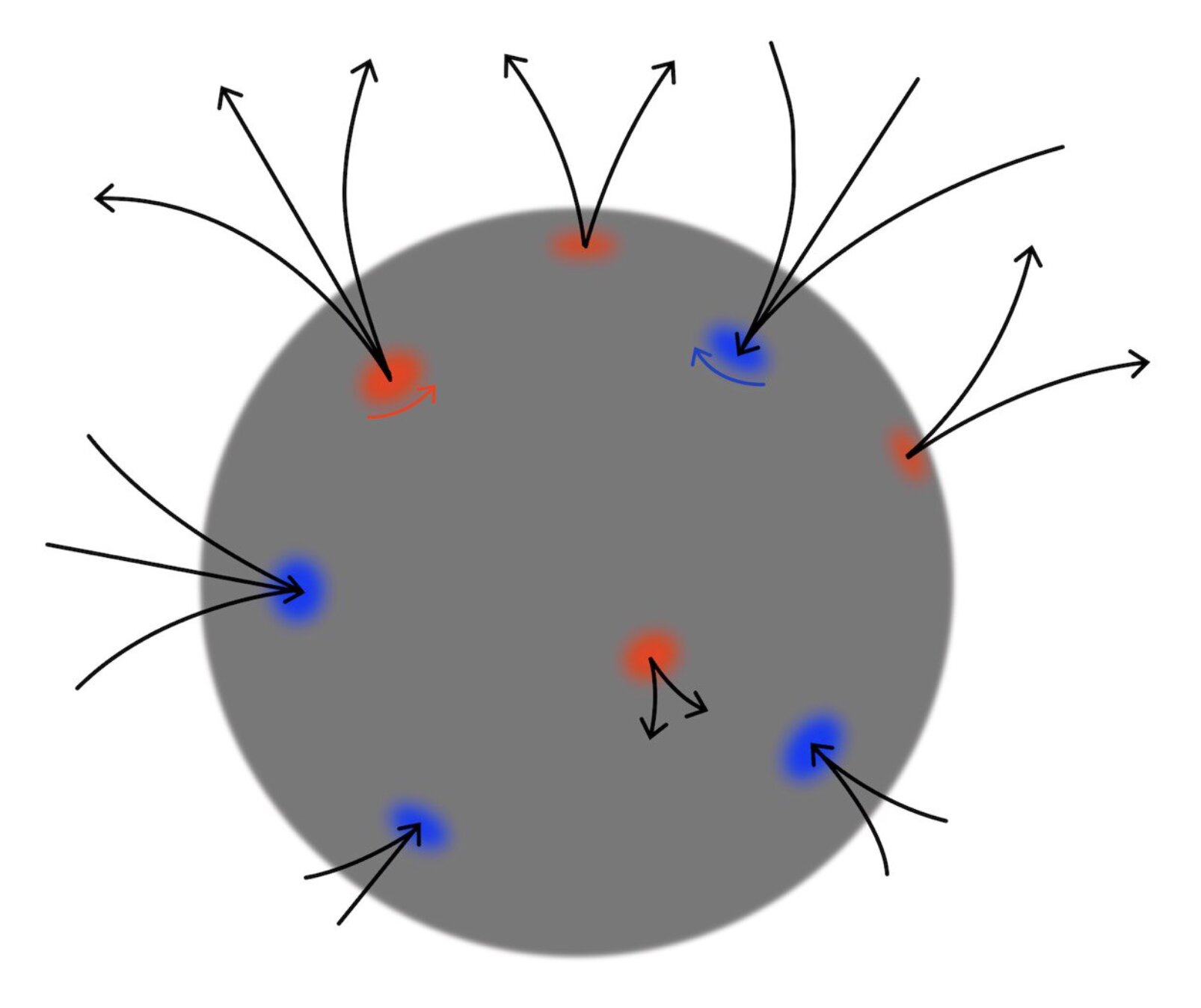
Image: Sketch of a black hole with a number of randomly oriented vortex/anti-vortex pairs. Colors denote the orientation of the vortex, with the associated trapped magnetic field lines in black. Credit: Dvali et al.
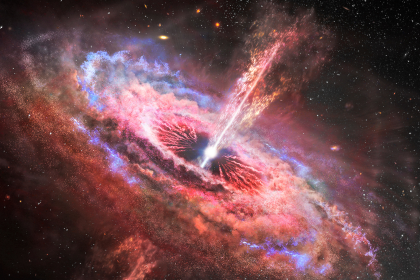
Authors show next that in the presence of mobile charges, the global vortex traps a magnetic flux that can have observable consequences at macro scale, like the jets observed in active galactic nuclei. As the authors explain in their paper, the jet power observed in M87, is so high it cannot be accounted for by the numerical simulations within the standard framework. Though within their saturon framework, the effect can potentially be accounted solely by vorticity, as the authors explained: “vortexes trap the magnetic field by interacting with the surrounding neutral plasma of either ordinary or a weakly-charged dark matter. Therefore, highly rotating black holes, can efficiently slow down due to the emission process; the vortex antivortex pairs are analogous to the proton, electron vortexes.”
Unified Science in perspective
In the frame of a vortex model, these PRL results get much closer to the solutions obtained by Nassim Haramein through his generalized holographic approach. The main features of this approach are described in our RSF article entitled The Generalized Holographic Model, Part II: Quantum Gravity and the Holographic Mass Solution, according to which the model:
- It accounts for the microstates of a BH in terms of Planck Spherical Units on both surface and volume, maximally packed in what is known as the flower of life pattern in 3D. These PSU represent the vacuum fluctuations, which as a first order approximation are considered each occupying a spherical volume with Planck length diameter.
- Because of the former point, this model accounts for maximal entropy.
- Because of these two points, Haramein’s framework accounts for the same behaviors, and proves that the BH interior is a saturated BEC of PSU’s. Therefore, the PSUs are analogous to the gravitons of the BEC saturon,
- Since the PSU are considered real oscillations (vortices at Planck scale which account as well for the quantum o action, or rotation, or angular momentum) of the Planck plasma vacuum, the collective behavior of the Planck plasma PSU’s creates bigger vortexes in multiple scales: it becomes a scale-invariant property.
- Haramein’s model is based on a fundamental holographic ratio: a steady state calculation representing an equilibrium information exchange rate like the kinetic constant in a chemical reaction, only that in Haramein’s case it represents the information transfer potential between surface and volume.
- Haramein’s model shows that the vacuum polarization also represented by the PSU, is at the origin of charge. Therefore, a spinning object composed of those PSU creating black hole vortex structures explains the extremely strong magnetic fields emerging from active galactic nuclei in our universe, as this PRL sustains as well.
In fact, these vortexes are at the root of almost all known galactic magnetic fields. This is another prediction of Haramein’s model, which was the first to propose, more that 25 years ago, that at the center of galaxies there should be a black hole because they are the precursors of galaxy formation.
Space-time bends and twists on itself in a vortex-spiral. This generates spin, a kinetic moment. […] This is the source of the spin of everything. This is an appropriate way to describe the physics of angular momentum in the universe in a factual way.
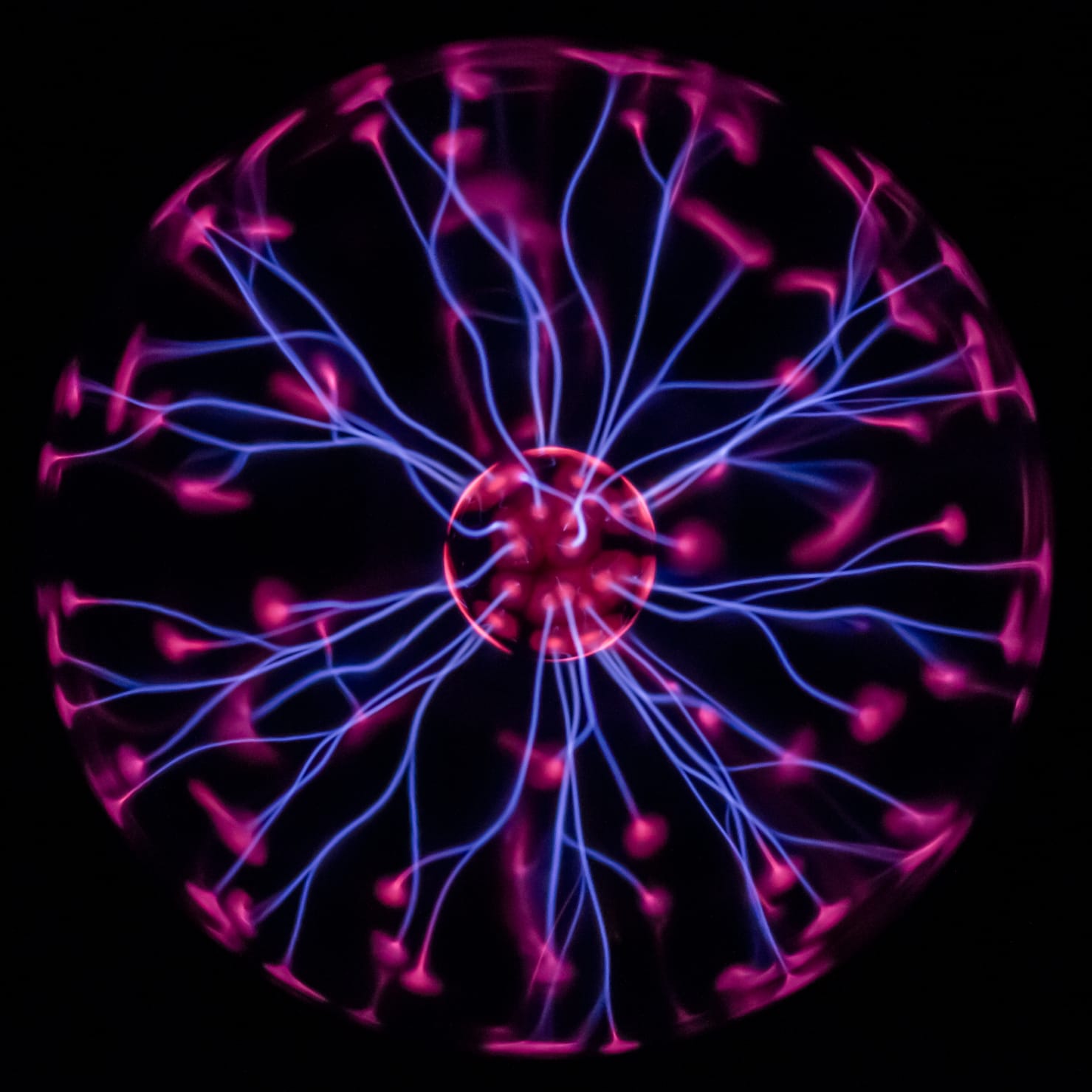
Nassim HarameinAn analogy for it are the plasma balls shown below, where the blue lines connecting surface to center are vortexes (like the sun spots too). These vortexes at the surface of the system are going to singularity … just as the Eddie currents representing electrons at the surface of protons. This is how the holographic theory conceives the behavior of the Planck plasma at multiple scales.
The whole scaling law model explaining the multiple phases and dynamics of the Planck plasma and its behavior across scales is already completed. More information about Haramein’s latest paper, can be found here: Scale Invariant Unification of Forces, Fields and Particles in a Quantum Vacuum Plasma [3].
References
[1] Gia Dvali et al, Vortices in Black Holes, Physical Review Letters (2022). DOI: 10.1103/PhysRevLett.129.061302
[2] Alfaro, J., Mancilla, R. Thermodynamics of graviton condensate. Eur. Phys. J. C 81, 871 (2021). https://doi.org/10.1140/epjc/s10052-021-09638-z
[3] Nassim Haramein & Olivier Alirol, Scale-invariant unification of forces, fields and particles in a Quantum Vacuum Plasma https://zenodo.org/records/4050623